My Doodle Space · By Jason Champagne · 2026-07-29
Goldendoodle Feeding Chart by Age & Size
How much should a goldendoodle eat? The honest answer is that no chart can replace watching your own dog, but a well-built starting point saves a lot of guesswork. Portion needs shift with age, adult size, activity level, whether your dog is spayed or neutered, and the calorie density of the specific food in your bowl — which is why two goldendoodles of the same weight can genuinely need different amounts.
Use the interactive chart below as your starting point, then adjust based on body condition over the following two to three weeks.
How to read a feeding chart without over- or under-feeding
Every feeding chart, including the one above and the one printed on your food bag, is built around an average dog eating a food of average calorie density. Two variables break that assumption immediately.
The first is calorie density. Dry dog foods commonly range from roughly 320 to 480 calories per cup. That means the same "2 cups a day" can be anywhere from about 640 to 960 calories depending on the bag. Before you trust any cup measurement, find the kcal/cup figure on your food's label — it is usually in small print near the guaranteed analysis — and treat calories, not cups, as the real unit.
The second is the individual dog. Neutered and spayed dogs typically need somewhat fewer calories than intact dogs of the same weight. A dog who hikes daily needs more than one who gets a twenty-minute neighbourhood loop. Age matters too: growth is calorie-expensive, and most dogs need noticeably less food once growth finishes than they did at six months old.
Feeding by life stage
8 weeks to 4 months
This is the highest-calorie stretch of your dog's life relative to body weight. Puppies at this age do best on three to four meals a day, spaced evenly, because their stomachs are small and their blood sugar drops faster than an adult's — especially in mini goldendoodles, where very low blood sugar is a real concern in tiny puppies.
Feed a food formulated for growth. For any doodle likely to exceed about 50 pounds as an adult, choose one labelled for large-breed growth: these are formulated with controlled calcium and energy levels to slow the growth rate slightly, which orthopaedic research links to lower rates of developmental joint problems. Faster is not better in a growing dog.
4 to 9 months
Appetite is usually enormous and growth is still fast, but you can drop to three meals a day somewhere around four to five months, and to twice daily by six to nine months for most dogs. Weigh your puppy roughly every two weeks and plot the trend rather than reacting to single readings. Our puppy weight calculator gives you a projected adult size, which is useful for choosing the right food formula.
9 to 18 months
Growth slows first in minis (often largely done by 9–12 months), then mediums, then standards (12–18 months, with filling out into the second year). The most common feeding mistake in doodles happens here: owners keep feeding a growth portion after the growth has stopped, and the dog quietly gains a few pounds a month. When your dog's weight has been flat for a month or two, transition to an adult formula and recalculate portions.
Adulthood
Most adult goldendoodles do well on two meals a day. Twice-daily feeding tends to be easier on the digestive system than one large meal, and in deep-chested dogs it is generally preferred over a single big feed. Recheck portions any time your dog's routine changes — a new job schedule that shortens walks is a portion change too.
Seniors
From around seven to nine years, depending on size, activity often drops while appetite does not. Some seniors need fewer calories and more protein to preserve muscle; others, especially very old dogs, lose condition and need calorie-dense food to hold weight. This is the life stage where charts help least and your vet helps most.
Body condition beats the scale
The most useful feeding tool you own is your hands. Run them over your dog's ribs: you should feel each rib with light pressure, the way you can feel the knuckles on the back of your hand. Look down from above — there should be a visible waist behind the ribs. Look from the side — the belly should tuck up rather than run straight back.
If ribs are hard to find, reduce the daily amount by about 10 percent and reassess in two to three weeks. If ribs are sharply visible and the waist is severe, increase by roughly 10 percent. Change one thing at a time and give it a fortnight before judging; day-to-day weight fluctuates enough to mislead you.
Treats, chews and the 10 percent rule
Treats should stay under about 10 percent of daily calories. This is where most well-fed doodles go over budget, because training treats, dental chews, and the odd crust of toast are rarely counted. A single medium dental chew can be 70–100 calories — a meaningful share of a mini doodle's daily intake.
Two practical fixes: measure the day's food in the morning and pull training treats out of that same portion, and switch to smaller rewards. Dogs respond to the event of a treat far more than its size, so a pea-sized piece works nearly as well as a whole biscuit.
Living with this in my own house
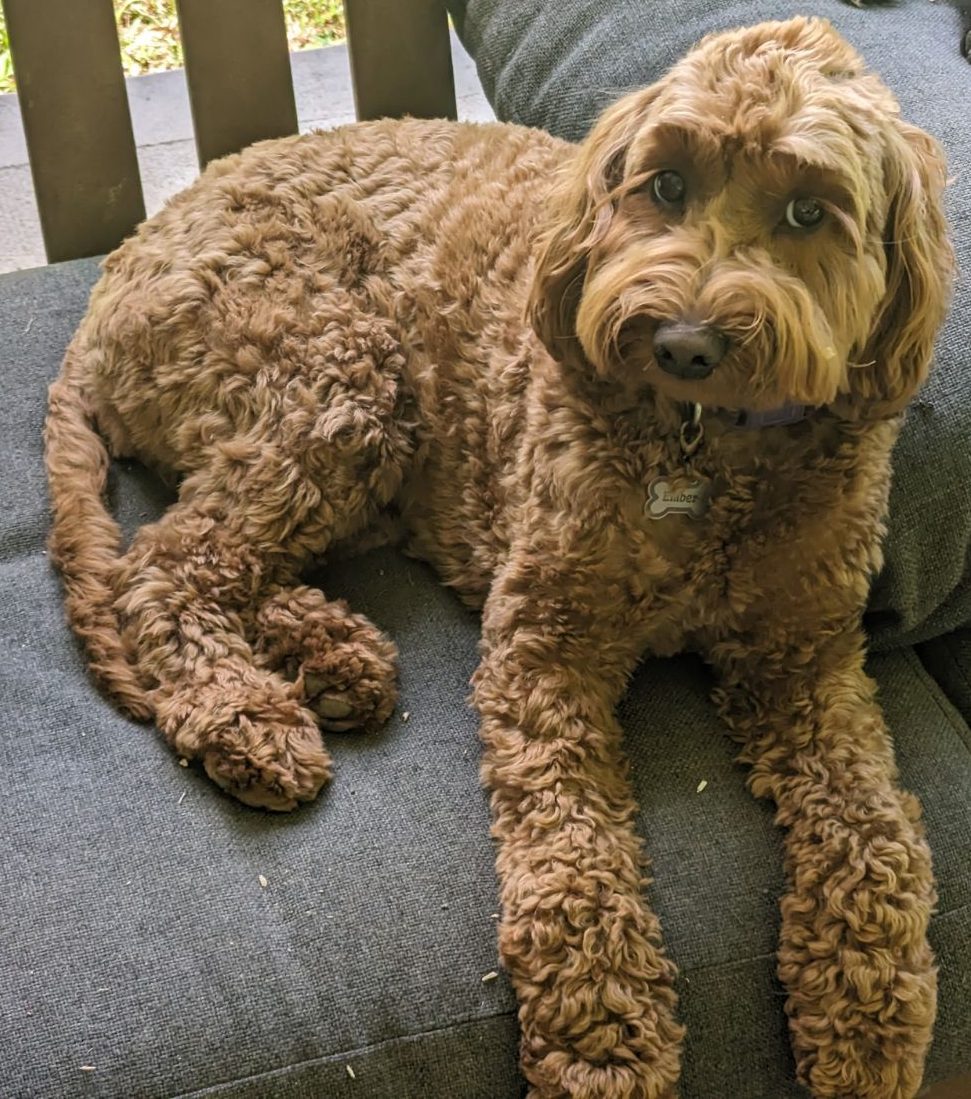
I have two goldendoodles, Buddy and Myla, both 18 months old and both wavy-coated — and they eat differently despite being littermate-sized dogs in the same home. Buddy inhales his bowl and would happily eat Myla's too; Myla grazes, walks away, and comes back twenty minutes later. For a long while I fed them identical portions because it seemed fair, and the result was Buddy carrying a little more weight than he should have while Myla stayed lean.
What finally worked was simple and unglamorous: separate bowls in separate rooms, both measured with an actual kitchen scale rather than a scoop, and Buddy's training treats subtracted from his dinner rather than added on top. I also stopped judging progress by the number on the scale week to week and started running my hands over their ribs every Sunday, which is a much faster signal than waiting for a vet visit.
The other thing I underestimated was how much the transition out of puppy food mattered. Around a year old they were still eating like growing puppies because nothing looked wrong — and the adjustment, when I finally made it, was larger than I expected. If you only take one thing from this article, make it that: when growth stops, the food has to change with it.
Switching foods without upsetting a stomach
Change food over seven to ten days: roughly 25 percent new food for three days, 50 percent for three days, 75 percent for two days, then fully across. Doodles with sensitive digestion may need two full weeks. Loose stool during a transition usually means you moved too fast; step back to the previous ratio for a few days rather than abandoning the new food outright.
When to stop adjusting and call your vet
Charts and body condition scoring handle ordinary portion tuning. They do not handle sudden change. Book a veterinary appointment if your dog loses or gains weight without a change in feeding, refuses food for more than a day, eats normally but keeps losing condition, or develops persistent loose stool, vomiting, or excessive thirst. Unexplained weight change is a symptom, not a feeding problem, and no chart can diagnose it.
Related reading
- Building a Healthy Doodle Diet — meals, treats and portions in more depth
- Doodle Puppy Weight Calculator — project adult size before choosing a formula
- Common Doodle Health Issues — what weight change can signal